ME 438 Final Paper · Duke · Spring 2026
Constructal Law vs. the Cosmic Web
Final paper for ME 438 at Duke. The project took an existing physics claim (that the cosmic web should obey the same branching rules as river basins) and tested it against 70 IllustrisTNG simulation snapshots. Three of the five predictions hold. Two don't.
What it is
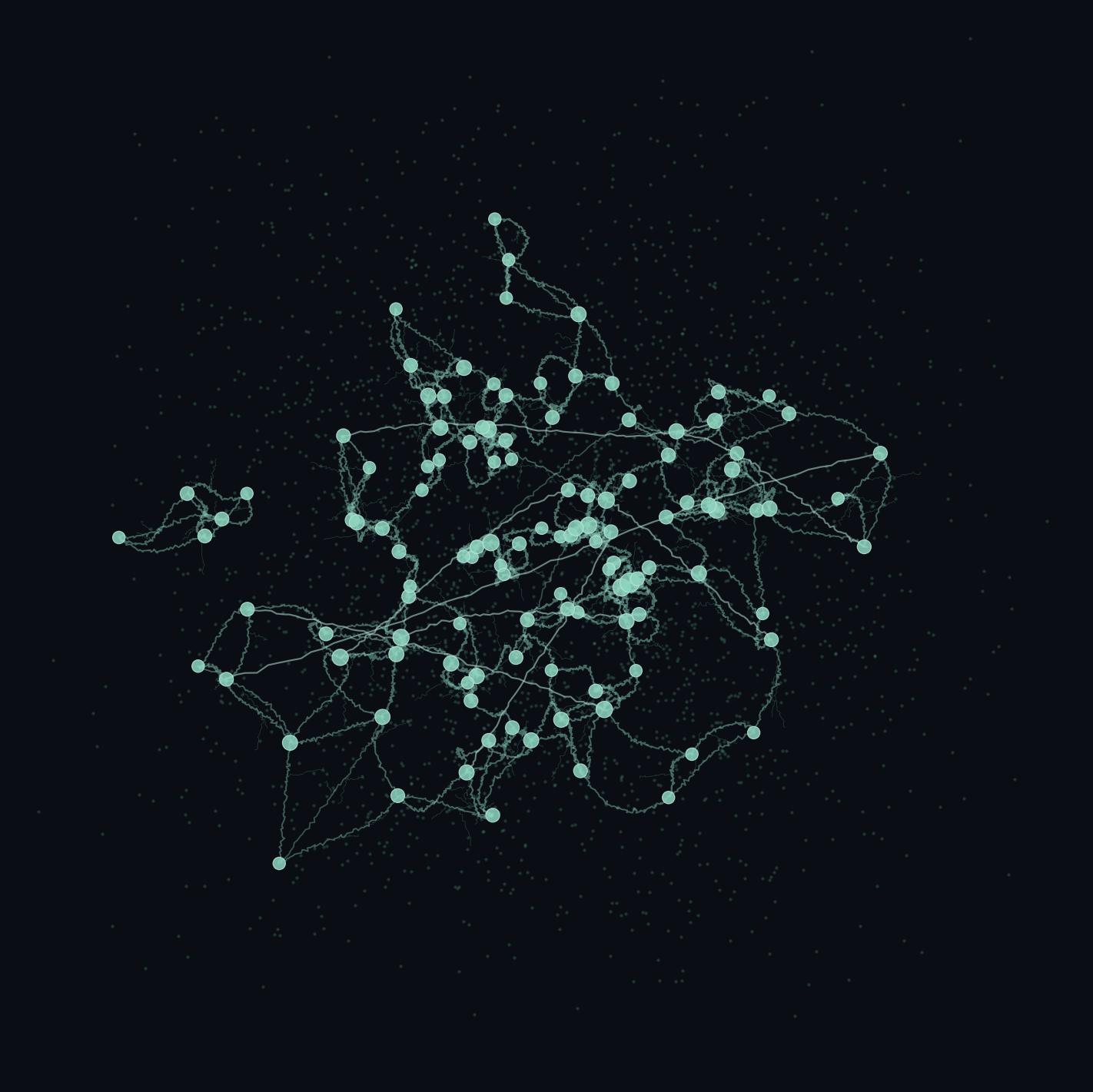
The universe isn't smooth. Galaxies sit on long thread-like filaments, and the filaments meet at nodes; the result is called the cosmic web. A pair of physicists claimed in 2022 that the same branching rule that explains river systems and lung airways should apply to that web. If true, the cosmic web is a flow network and you can predict its shape with a single principle.
I tested that claim on a published simulation of the universe (IllustrisTNG) over 70 time slices spanning ten billion years. The branching counts and scaling came out close to the prediction. The angles between filaments did not. So the topology of the web (what connects to what) looks like a flow network. The geometry (how those connections sit in space) does not.
How it works
Constructal law (Bejan 1996, extended to the cosmic web in Bejan & Lorente 2022) predicts five quantities for a flow network: bifurcation ratio RB ≈ 4 (or 3 for hexagonal packing), length ratio RL ≈ 2, Hack's exponent h ≈ 1/3, a drainage-mass scaling, and 3D junction angles bounded by ~77°. The pipeline runs all five against TNG300-1 with a TNG100-1 cross-check.
For each snapshot: h5py streams the density field, scipy.ndimage plus a
custom persistence filter does DisPerSE-style ridge extraction, NetworkX handles the
Horton-Strahler ordering, and the five quantities drop out of the resulting forest. Unit tests on
the ordering algorithm, checked against hand-computed toy trees, caught two edge cases.
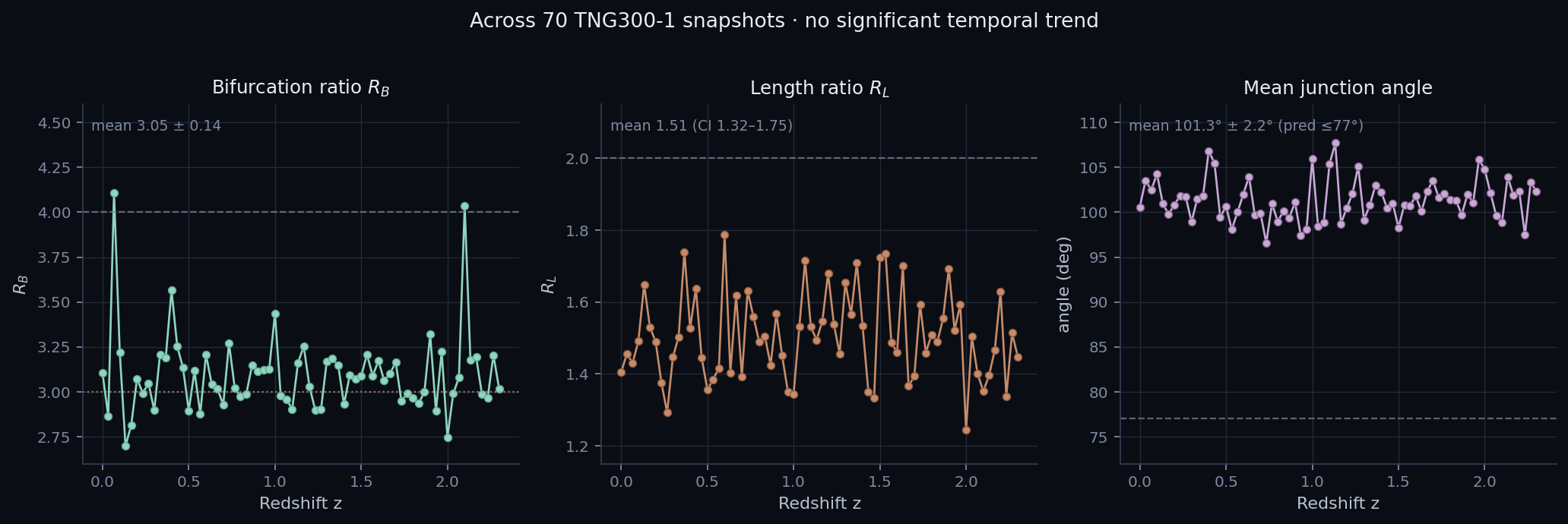
- RB = 3.05 ± 0.14. Within 2% of the hexagonal-packing optimum, four σ from RB = 4.
- RL = 1.51, 95% CI [1.32, 1.75]. Inside the empirical river-network range but below Bejan's 2.0.
- Hack's exponent h = 0.310 ± 0.019, R² = 0.88, p < 10⁻⁴⁸. Slightly below 1/3, but the scaling exists.
- Drainage-mass scaling slope = 1.34, R = 0.93, p = 0.0025. The geometric progression is observed.
- Junction angle = 101.3° ± 37.7°. Predicted ≤77°. Hard break.
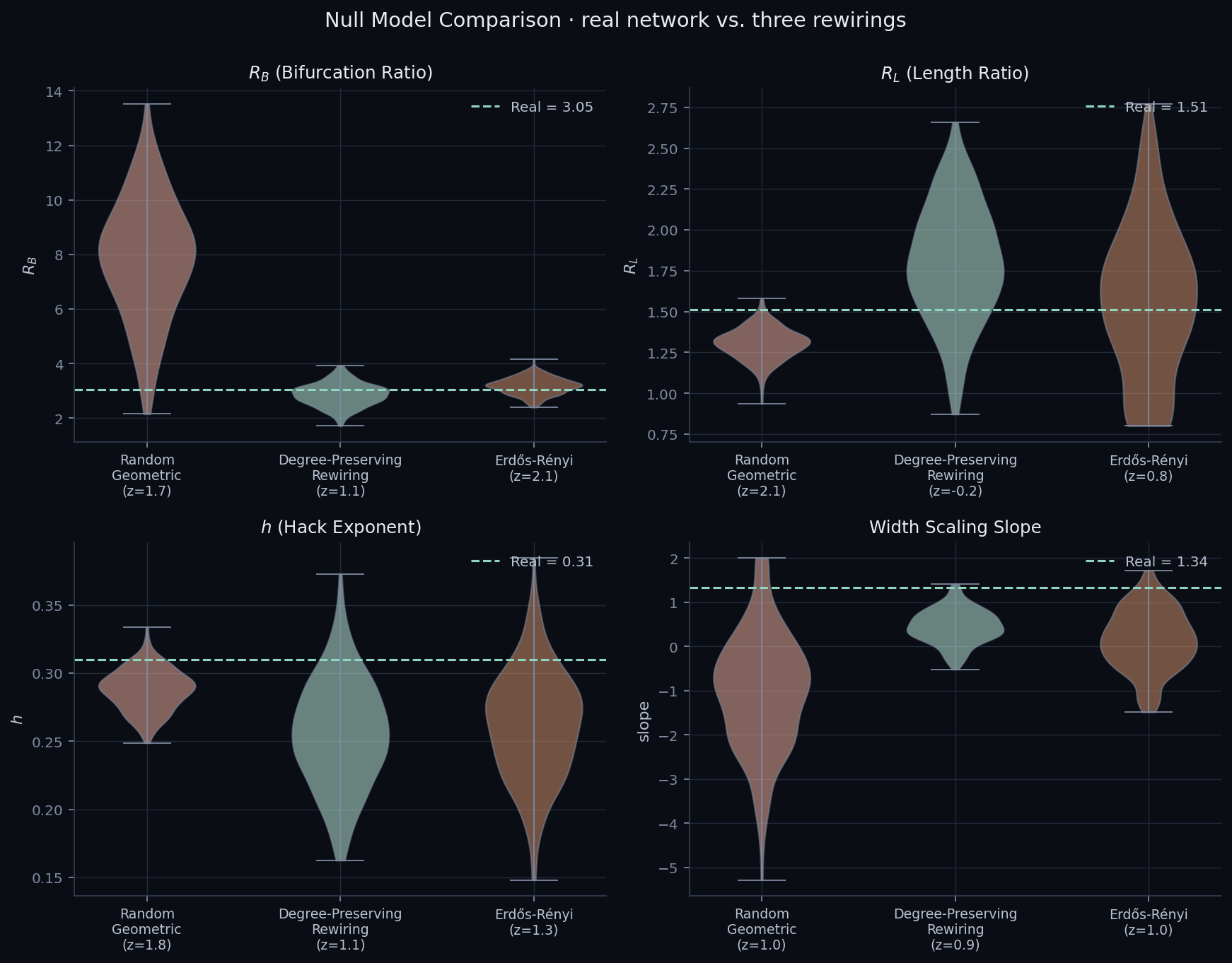
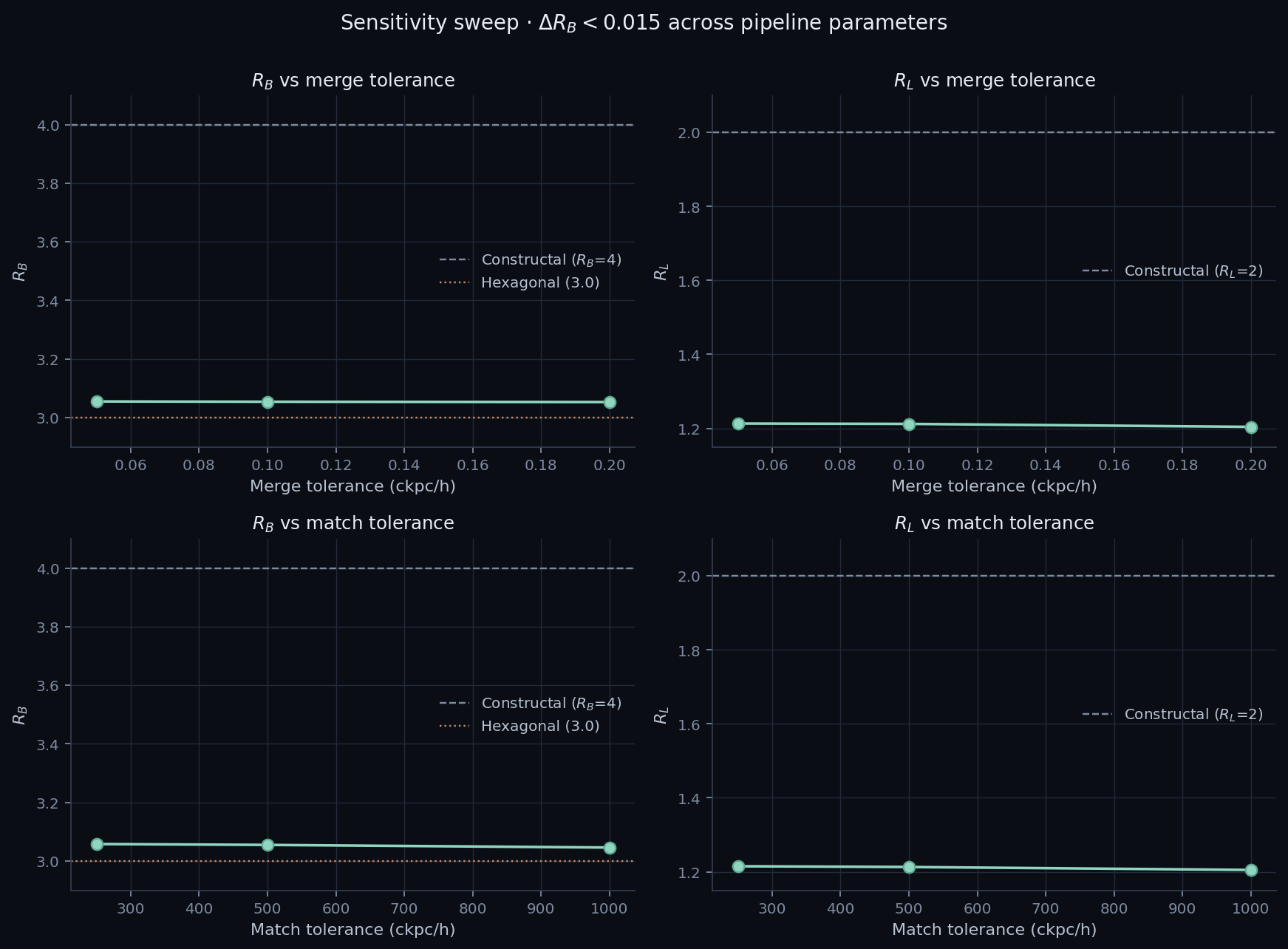
The null model controls (random, degree-preserving, and Erdős-Rényi rewirings) are distinguishable from the real network on Hack's law and on width-scaling, weaker on RB alone. A sensitivity sweep over the persistence threshold gives ΔRB < 0.015, so the topological result isn't a parameter artifact. TNG100-1 cross-check: same pattern.
Where it's at
Accepted for oral presentation at the 16th Constructal Law Conference (Design in Nature: The Evolution of Designs, CLC 2026), Paris, October 12–15, 2026. All 70 snapshots analyzed, null model done, sensitivity sweep done, TNG100-1 cross-check done. The interesting follow-up (what should the constructal angle prediction look like in a gravity-dominated regime, where the local viscous-dissipation argument breaks down) is more than a single paper, and not something I'm picking up next.